
Volume 2 Issue 5, Jul 2013
|
Ocean Currents and Ship Routing
By: Brandon Capasso, Senior Meteorologist
|

|
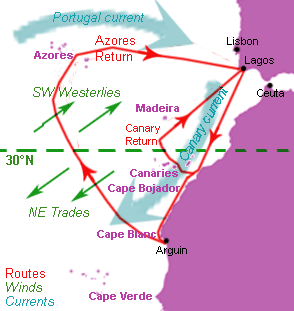
Figure #1: Henry the Navigator's
"Volta do mar" technique.
"Volta do mar" technique.
(click to enlarge)
In the recent past, satellite measurements have resulted in a leap forward in the understanding and prediction of ocean currents in the scientific community. For example, in 2008 scientists announced the discovery of a previously unknown current pattern called the North Pacific Gyre Oscillation, which answered long standing questions regarding changes in salinity and chlorophyll that have been observed over the Northeast Pacific. These same satellite measurements have also contributed to the development of the Hybrid Coordinate Ocean Model (HYCOM) and the Real-Time Ocean Forecast System (RTOFS) by a collaboration of scientists at Florida State University, NOAA, and the U.S. Navy. These models produce both an analysis and an accurate ocean current forecast covering nearly the entire globe that can be used in a variety of applications ranging from hydrographic and biological research to efficient ship routing.
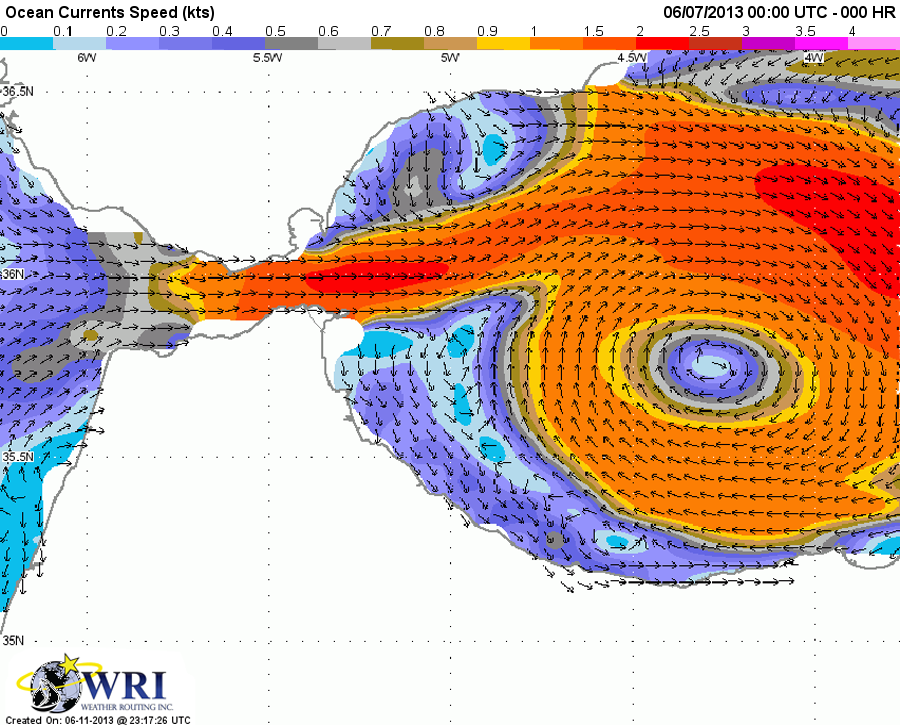
WRI provides RTOFS and HYCOM data to our clients through our Dolphin Fleet Management website (www.wridolphin.com) and Dolphin Voyage Planner, and in our detailed forecast advisories. Dolphin users can simply adjust the charts to any location at any zoom level with our dynamic "zoomable" map interface, with your ships current and future positions plotted on the charts.
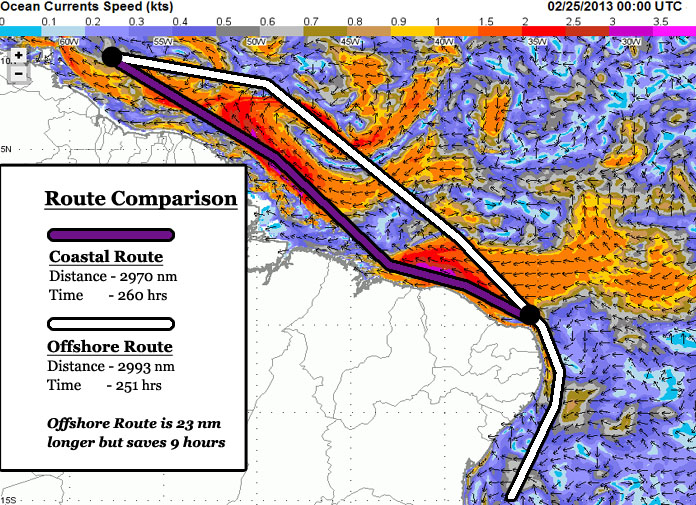
Figure #3 - The Guiana Current
(click to enlarge)
We also ingest RTOFS current data into our high resolution wave model, in combination with high resolution wind forecasts from the WRF-ARW model. This produces highly accurate wave height forecasts in areas where strong semi-permanent ocean currents meet opposite swell, locally amplifying the waves. These areas are also known to be particularly favorable for rogue waves, and can be dangerous for small or sensitive vessels.
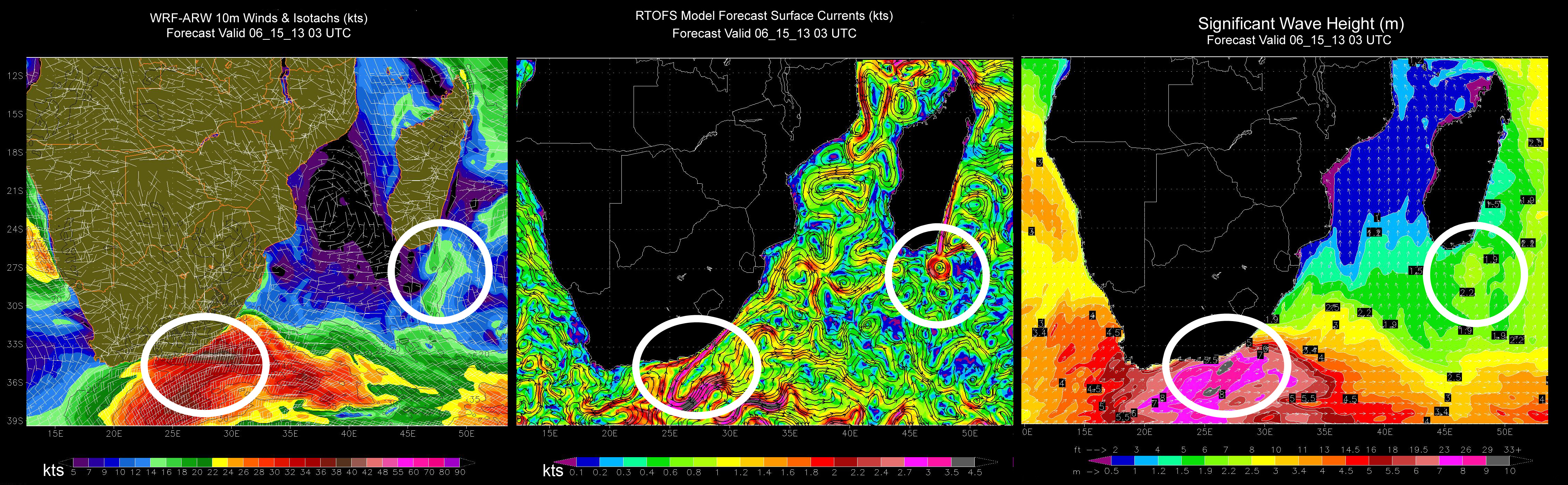
Figure #4 - WRF-ARW winds, RTOFS currents, and the resulting model forecast significant wave height.
(click to enlarge)
The use of high resolution current data allows WRI to always recommend the most efficient route possible, avoiding dangerous conditions for safety of the vessel and crew, and keeping our clients better informed and prepared for the conditions they will encounter at sea. Our innovative tools and detailed advisories will provide your fleet and operations with the information required to ensure safe and efficient transits. Contact WRI today to discuss how our services can be customized for your fleet!
In this issue:
WRI Services:
Contact us for a Forecast!
wri@wriwx.com
+1-518-798-1110
Dolphin Online Fleet Management
Click Here
Fleet Routing
Click Here
Tropical Surveillance
Click Here
Post Voyage Performance Analysis
Click Here
Route Deviation Analysis & Port Consumption Reports
Click Here
Tug & Barge Services
Click Here
Cruise Liner Services
Click Here
Dolphin Voyage Planner (DVP)
Click Here
DVP Examples
Click Here
SEEMP and WRI
Click Here
 Need a Forecast?
Contact our professional meteorologists
Need a Forecast?
Contact our professional meteorologists
24 hours a day, 365 days a year at
(518) 798-1110
or wri@wriwx.com
WRI Services:
Contact us for a Forecast!
wri@wriwx.com
+1-518-798-1110
Dolphin Online Fleet Management
Click Here
Fleet Routing
Click Here
Tropical Surveillance
Click Here
Post Voyage Performance Analysis
Click Here
Route Deviation Analysis & Port Consumption Reports
Click Here
Tug & Barge Services
Click Here
Cruise Liner Services
Click Here
Dolphin Voyage Planner (DVP)
Click Here
DVP Examples
Click Here
SEEMP and WRI
Click Here
Need a Forecast?
Contact our professional meteorologists24 hours a day, 365 days a year at
(518) 798-1110
or wri@wriwx.com