Newsletter

Weather Routing's Monthly TradeWinds Newsletter

Select an edition to view:

Yacht Newsletter
Volume 19 Issue 1 Jan 2026
Recapping the Uniqueness of the 2025 Atlantic Hurricane Season
Kyle Petroziello, Senior Meteorologist

Going into the season, an above average Atlantic Tropical Season was forecasted due to a few factors - mainly, a weak La Niña to ENSO-neutral condition in the El Niño Southern Oscillation (ENSO) pattern. This classifies the cooler than average Equatorial Pacific sea surface temperatures, which limits rising air and associated wind shear (strong upper-level winds) over the Tropical Atlantic Basin, which is a favorable ingredient in promoting tropical cyclone development. While this condition maintained true throughout the season and the lower-end range of this forecast still played out, there were some unique takeaways from the 2025 Atlantic Tropical Season:

  • 13 total named tropical cyclones (slightly below the consensus forecast average)
  • 5 of these being Hurricanes (slightly below average)
  • 4 Major Hurricanes (Category 3 strength or higher) (above average)
  • 3 of these reaching Category 5 status (well above average)
  • Zero U.S. Landfalling Hurricanes (first time in a decade)
  • For about a 3 week stretch during the climatological peak Atlantic Hurricane Season late August through mid-September, no systems formed at all.

2025 North Atlantic Tropical Tracks of 13 Named Systems (source: NOAA/NWS)

While the total number of named systems and classified hurricanes fell below expectation, the potentness was evident in those that did develop. Three Category 5 hurricanes (Erin, Humberto, and Melissa) is only the second time in recorded history this mark had been reached (since the infamous 2005 season, where four such systems occurred). What promoted such rapid intensification?

Sea Surface Temperatures (SSTs) over the western main development region of the Atlantic Tropical Basin were 1.5°C above average in 2025. This fuels tropical development due to the evaporation of warm seawater, providing humid rising air in which water vapor condenses in higher altitudes, resulting in extensive clouds and rain. This was a common theme for the 2024 Atlantic Tropical Season as well, when much of the main development region saw SST anomalies within the range of 0.5–1.5°C above average, a season that saw two Category 5 hurricanes develop. This adds to the available moisture in the atmosphere, another key ingredient in tropical development. Though, any such systems developing under these conditions cannot thrive with the presence of strong winds aloft, which can rip away at storms' ability to stack into the upper atmosphere. The persistence of a weak La Niña to ENSO-neutral condition in the ENSO pattern assisted to prohibit this wind shear, and under the perfect circumstances of these factors aligning over a given time and area, rapid intensification of tropical cyclones can blossom. Hurricane Erin tied for the 3rd largest 24-hour pressure drop of a system ever recorded in the Atlantic Basin, from 998mb to 915mb (-83mb).

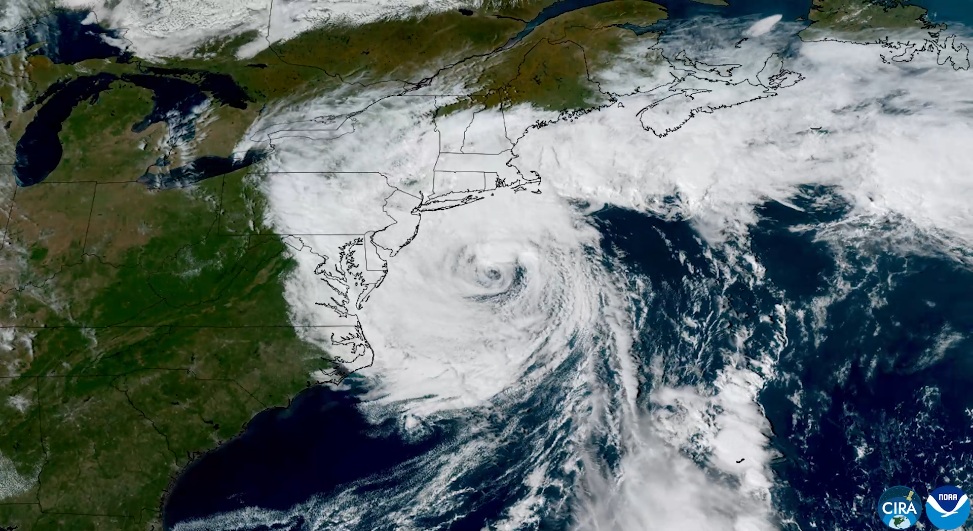
Hurricane Melissa caused catastrophic damage as it made landfall over Western Jamaica in late October, the final system of the season, then lifting NE'ward while gradually weakening over S'rn Cuba and the Bahamas, eventually passing just west of Bermuda. Upon landfall, Melissa had perfect satellite presentation, developing a menacing "buzzsaw" characteristic, as the eyewall was able to perfectly align miles into the atmosphere with surrounding symmetric banding. The system tied as the strongest landfalling Atlantic hurricane in recorded history with a central pressure of 892 mb and 160 kt sustained winds. The other Category 5 hurricanes - Erin and Humberto - significantly strengthened (Erin becoming the 7th largest Atlantic hurricane on record by size) while drifting north of the NE'rn Caribbean, ultimately re-curving N'ward to NE'ward to remain out to sea while passing well east of the Bahamas and U.S. East Coast in August and September respectively. This re-curving track was a common theme during the 2025 Atlantic Tropical Season, as no hurricane made U.S. landfall for the first time in a decade. Only a tropical storm, Chantal, tracked N'ward into NE'rn South Carolina in early July. What synoptically drove this anomaly?

Synoptic Pattern during the 2025 Atlantic Hurricane Season and Common Tropical Track

A large subtropical high over the North Atlantic is the most significant steering factor of tropical tracks for Atlantic hurricanes. When this is strong, this forces cyclones further west before these lift N'ward, putting the U.S. more in play for direct impact. However, when this is weakened, this allows systems to turn N'ward sooner, and eventually NE'ward as these are often guided by the jet stream into higher latitudes. This season, an expansive upper-level trough of low pressure was a consistent feature over the Eastern Seaboard, extending offshore at times. This aided to weaken the neighboring subtropical high pressure ridge, causing weaker steering and a sooner N'ward turn to many of the Atlantic tropics this season. This ultimately favored a more S'rn approach for many trans-Atlantic client crossings this past fall towards the NE'rn Caribbean, while the Florida and N'rn Bahamas region was provided peace of mind from re-curving cyclones.

While the 2025 Atlantic Tropical Season fell below forecast of total named systems and featured a rarity of U.S. misses, those that did develop proved the powerful intensity capable when conditions did align. As we head into 2026, the ENSO pattern suggests we are transitioning into an El Niño phase during the tropical season, which typically hinders Atlantic tropical potential. However, a battle with an above average SST trend in recent years will be key to watch. WRI's official 2026 Atlantic Tropical Outlook will come in greater detail later this Spring.

Climatology Studies To Help You Plan For The Year Ahead
Alex Avalos, Operations Manager

As you use the new year to make plans for the next twelve months, you might be wondering whether the prevailing weather patterns in a given area around the world will allow for favorable travel in those regions. Because the weather can at times, significantly vary over the course of the year, WRI offers a service called the Climatology Study which can assist you with the planning process.

Similar to our passage forecasts, these studies take into consideration your vessel's particular needs, and provide a "go" or "no-go" recommendation based upon the wind and sea constraints that you provide us. Our team of Meteorologists provides a detailed analysis into the feasibility of your preferred passages at a given time of year. These reports include, but are not limited to the following:

•    A detailed synopsis, discussing the most common weather features in the part of the world that you plan to travel at a given time.
•    Descriptive facts on the best routes to utilize, along with the pros and cons of each.
•    A discussion on the feasibility of your transit at that time of year, and whether there is a better time to make the trip(s).
•    A detailed table which shows the break down of usual conditions against the vessel’s constraints on an evaluated route. 

Above is an example of the detailed climatological statistics which we include in every report we evaluate. View a complete sample climatology study here:

If you have any questions about our Climatology Studies, you can contact us at any time, as we are available around the clock for all of your forecasting and routing needs. Our team of Meteorologists is always available to discuss these reports with you over the phone, or in a Zoom briefing at a small, additional charge.

Upcoming Events
28 April, 2026 - Weather Routing to Present Webinar for Sailing and Boating, LLC:
17 - 20 September, 2026: Newport International Boat Show
15 - 18 October, 2026: Annapolis Boat Show
28 October - 1 November, 2026: Fort Lauderdale International Boat Show
Product/Services
SeaWeather Trials
Yacht Services
Marina Services
Race & Rally Services
Angler Services
Special Projects
NEW SeaWeather App

Social Share Buttons and Icons powered by Ultimatelysocial